Is Modular Construction the Right Solution for Your Business Building?
Business Inspo


Modular buildings have become one of the most sought-after construction solutions in the modern business world. Many entrepreneurs have shifted from conventional building methods to modular systems, which are faster, more efficient, and highly flexible. However, before deciding to adopt this method, it is essential to understand whether modular buildings are truly suitable for commercial use, as well as their advantages and construction process.
This article provides a comprehensive overview, covering trends, definitions, workflows, suitable business types, and the benefits for your enterprise.
The Modular Building Trend in Modern Business
In recent years, the use of modular buildings for commercial purposes has increased significantly. This trend has emerged due to shifting needs in the business world:
A. Modern Business Demands Speed
Companies aim to open new branches much faster than traditional construction allows, which can take 3–6 months or longer.
B. Rising Conventional Construction Costs
The continuous increase in material and labor costs has pushed business owners to seek more affordable construction solutions.
C. Flexibility as a Core Necessity
Several business types require structures that can be relocated, expanded, or modified according to business growth.
D. Rapid Growth in F&B and Retail
Cafes, restaurants, minimarkets, and business booths require ready-to-use building models that can be operational immediately.
For these reasons, modular buildings have become a dominant trend in the business world, especially in urban areas and developing locations.
Why Are Business Owners Turning to Modular Buildings?
Here are the primary reasons why modular buildings are preferred over conventional ones:
Rapid Process
Modular buildings can be completed 50–70% faster because the production process takes place in a factory rather than on-site.
Cost Efficiency
Construction costs are more controlled as materials are mass-produced with high precision.
Minimal Site Disruption
For businesses in busy areas, conventional construction often disrupts surrounding activities. Modular systems only require a short assembly time on-site.
Relocatability
Modular structures can be dismantled and moved if the business location changes.
Highly Customizable
They can be tailored to specific needs, from size and interior design to layout and additional space.
Defining Modular Buildings
A modular building is a structure composed of separate units or "modules" produced in a factory, then transported and assembled at the project site. Each module is built as a complete building component consisting of:
Wall structures
Flooring and Roofing
Electrical and Plumbing installations
Ventilation
Interior finishing
This method ensures superior building quality, as the process follows strict industrial factory standards.
Workflow and the Modular Construction Process
To understand why modular buildings are faster and more efficient, here are the construction stages:
A. Planning Stage
This includes 3D design, determining module dimensions, layout, and material specifications.
B. Factory Production
This is the core of the modular system. The process is executed with industrial precision, involving:
Fabricating steel structures or panels.
Installing walls, floors, electricity, and plumbing.
Fitting windows, doors, and interior panels.
Basic finishing.
Note: On-site foundation preparation occurs in parallel with this stage.
C. Delivery and Installation
Modules are transported via truck and assembled using a crane. This process can be completed in 1–3 days, depending on the number of modules.
D. Final On-Site Finishing
This involves joining the modules, electrical inspections, additional painting, and furniture installation if required.
Total construction time can range from just 2 to 8 weeks, significantly faster than conventional methods.
Business Types Suitable for Modular Buildings
Modular buildings are highly versatile and can be utilized for various industries:
Food & Beverage (F&B)
Modular coffee shops, take-away booths, and ready-to-use kitchens.
Retail
Stores, boutiques, barbershops, pharmacies, or mini-marts.
Offices and Coworking Spaces
Startups, architectural firms, project offices, and portable meeting rooms.
Healthcare Services
Modular clinics, consultation rooms, treatment areas, and pharmacies.
Education
Temporary classrooms, training rooms, mini-libraries, and laboratories.
Manufacturing & Industrial
Security posts, operator rooms, small warehouses, and mini-workshops.
Hospitality:
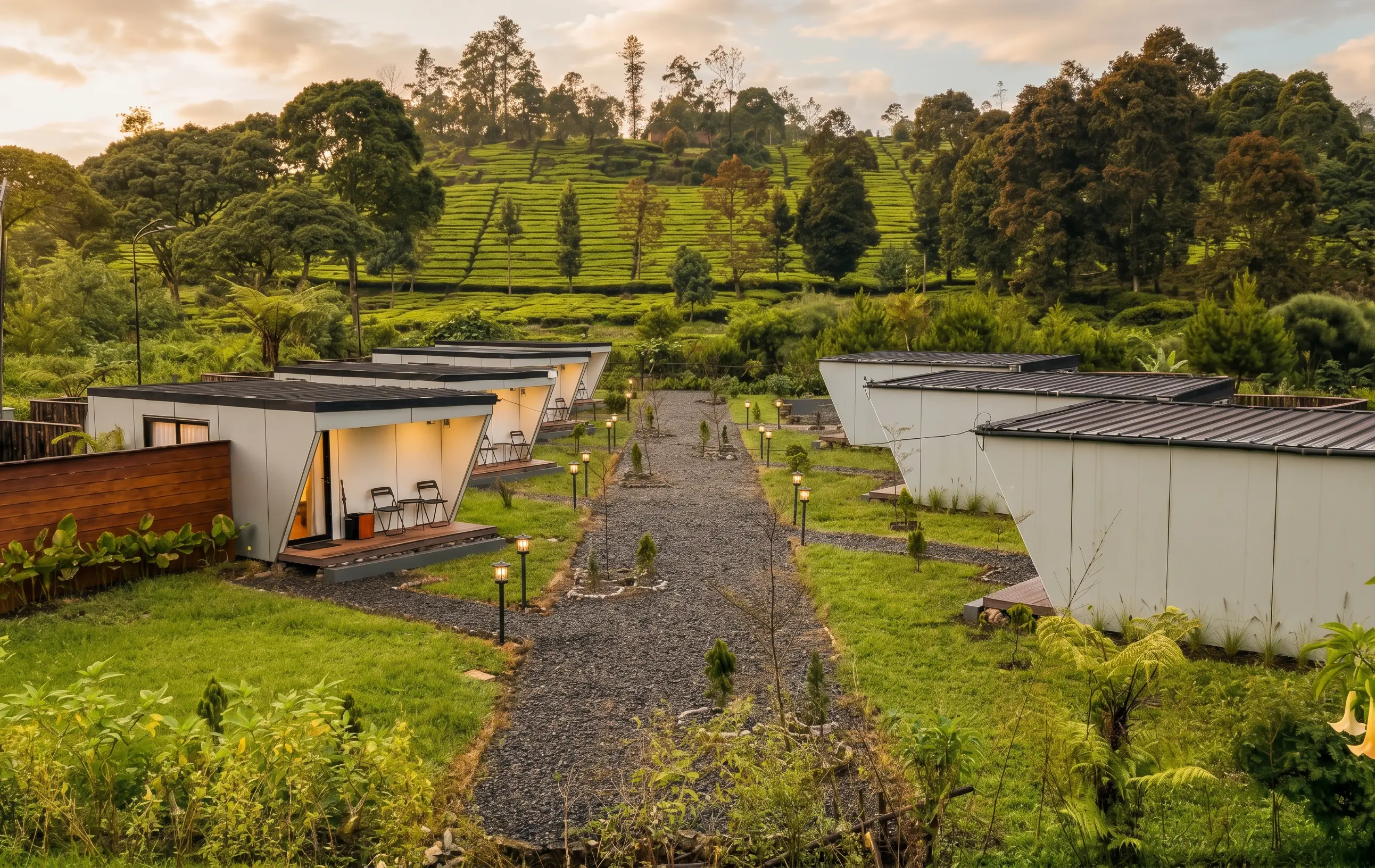
Glamping cabins, modular villas, portable lodgings, and modular resorts.
Key Advantages of Modular Buildings for Commercial Use
Modular systems offer several strategic benefits:
Construction Speed
Projects are completed in weeks, allowing for faster operational start dates and quicker ROI.
Budget Efficiency
Mass production reduces material waste and labor costs.
Consistent Quality
Factory-grade standards ensure higher precision than manual on-site work.
Design Flexibility
Owners can add space, relocate the building, or change the layout at any time.
Sustainability
Modular construction is more eco-friendly due to significantly reduced production waste.
Durability
High-quality materials such as light-gauge steel, sandwich panels, and metal frames ensure a robust, long-lasting structure.
Want to find out if a modular building is the right fit for your business needs? Consult with AMODA today.
Tag: